
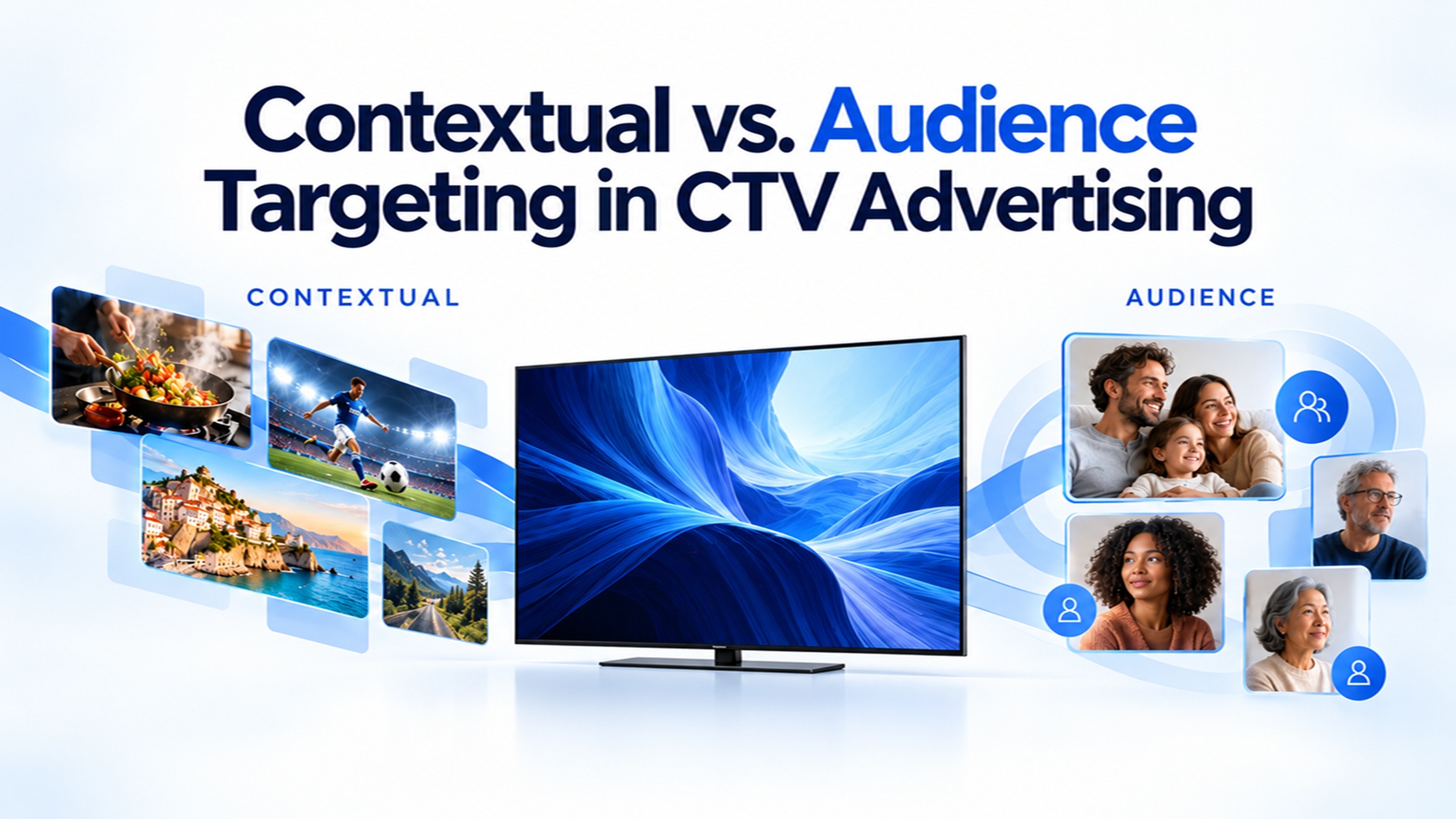
Contextual targeting focuses on the content surrounding an advertisement. Audience targeting focuses on the characteristics or behaviors associated with the people or households receiving it. Both can help advertisers improve relevance, but they answer different questions.
Understanding how these approaches work—and where their limitations lie—helps brands build more thoughtful CTV campaigns.
What Is Contextual Targeting in CTV?
Contextual targeting places advertisements alongside content that aligns with a brand, product, or message. Instead of selecting a household based on its audience profile, an advertiser selects a relevant viewing environment.
For example, a cookware company might advertise during cooking programs. A sportswear brand could choose fitness content, while a home improvement business might select renovation shows.
Depending on the publisher and advertising platform, contextual signals can include genre, subject matter, language, content rating, and more detailed classifications. However, the level of precision depends on the metadata available and shared across the advertising supply chain. IAB Tech Lab identifies content metadata and classification as important components of contextual targeting in CTV. The appeal is straightforward: the advertisement connects with what someone is watching at that moment.
A meal delivery service, for instance, could use a cooking program placement to introduce a message about enjoying good food when there is little time to prepare it. The content provides a natural setting for the offer.
Still, contextual relevance does not establish purchase intent. Someone watching a renovation show may enjoy the transformations without planning to renovate their own home.
What Is Audience Targeting in CTV?
Audience targeting uses data to identify households or viewers that match an advertiser’s desired customer profile. The advertisement can then reach those audiences across eligible content, rather than being restricted to a particular subject or genre.
An automotive company, for example, might target households associated with vehicle shopping activity. Those households could receive its advertisement while watching entertainment, news, or sports.
Depending on the platform, audience segments may draw on:
- Demographic characteristics.
- Interests and behavioral signals.
- Purchase activity or inferred buying intent.
- First-party customer relationships.
- Third-party audience data.
Some platforms also support the use of advertisers’ first-party audiences for CTV activation. Google’s Display & Video 360 documentation, for example, describes using these audiences to extend household reach.
However, television is frequently a shared screen. A household associated with a particular interest may contain several people with different needs. Audience targeting therefore does not necessarily confirm which individual is watching an advertisement. IAB highlights this household-level uncertainty as a limitation for CTV targeting and measurement.
Contextual vs. Audience Targeting: Key Differences
The central difference is the basis for selecting an advertising opportunity.
| Factor | Contextual Targeting | Audience Targeting |
|---|---|---|
| Primary focus | The content being watched. | The attributes associated with a household or viewer. |
| Main inputs | Content metadata and classifications. | Customer data, audience segments, and identity signals. |
| Typical use | Aligning a message with a relevant viewing environment. | Reaching selected customer groups across content. |
| Main accuracy concern | Incomplete or incorrect content classification. | Outdated segments or inaccurate household matching. |
| Privacy consideration | Can reduce reliance on personal identifiers for ad selection. | Requires attention to data permissions and usage. |
| Reach limitation | Availability of suitable content. | Size and accessibility of the selected audience. |
| Cost considerations | Inventory pricing and contextual service fees. | Inventory pricing, audience data, and activation fees. |
Neither approach is automatically cheaper or more effective. Campaign costs and outcomes depend on inventory, competition, targeting restrictions, creative quality, and the business objective.
Benefits and Limitations of Contextual Targeting
It Connects the Message With the Viewing Moment
Contextual targeting gives advertisers an opportunity to make creative feel more relevant.
Consider an outdoor equipment brand appearing during an adventure series. An advertisement about preparing for a weekend outdoors fits naturally into that setting. The surrounding content can provide a useful starting point for the message.
This alignment works best when the creative reflects the context. A generic advertisement may miss an opportunity that a more carefully matched message could capture.
It Can Reduce Reliance on Audience Identity
Content-based selection can operate without requiring a detailed profile of the viewer. That makes contextual targeting useful for advertisers seeking to reduce their dependence on identity-based audience selection.
However, contextual selection should not be confused with an entirely data-free campaign. Delivery, frequency management, and measurement may still involve additional signals, depending on the setup.
It Supports Brand Suitability Decisions
Selecting content categories can help advertisers choose environments that fit their brand. Yet a broad category alone cannot guarantee suitability.
Two programs within the same genre may differ substantially in tone and subject matter. Advertisers should understand how inventory is classified and what controls are available.
Its Precision Depends on Content Information
Contextual targeting becomes less useful when metadata is sparse, inconsistent, or too broad. A general “entertainment” classification provides less guidance than a reliable description of a program’s specific subject.
Narrow content selections can also limit campaign scale. Advertisers must balance relevance with the amount of eligible inventory available.
Benefits and Limitations of Audience Targeting
It Reaches Customer Groups Across Viewing Interests
Potential customers do not spend all their viewing time watching content related to a product. Someone considering a new car might watch comedy more often than automotive programming. Audience targeting can help an advertiser reach that household across different viewing environments. This flexibility is valuable when a product’s likely buyers do not share an obvious content preference.
It Can Support Different Customer Objectives
Where platform capabilities and data permissions allow, advertisers can use audience selection to support acquisition, customer retention, or exclusions. For example, a subscription business might exclude existing subscribers from an introductory offer. Another campaign could promote an additional service to eligible customers. These uses depend on successful matching and platform support; an uploaded customer list does not guarantee that every customer can be reached.
Data Quality Shapes the Result
An audience segment is only as useful as the signals behind it. Shopping interests change, customer records become outdated, and inferred characteristics may be incorrect. Before selecting a segment, advertisers should ask how it was created, how recently it was refreshed, and whether its underlying signals match the campaign’s purpose.
Narrow Audiences Can Create Delivery Problems
Highly restrictive targeting may reduce reach and concentrate impressions among a small number of households. That can increase repetition without producing enough new exposure. A campaign needs sufficient scale to deliver consistently and generate useful evidence about performance.
How to Choose the Right Approach
Begin with the business objective. For a brand seeking awareness within a relevant subject area, contextual targeting offers a clear starting hypothesis. A specialist cooking product, for example, has an understandable connection with food programming.
For a business trying to reach a defined customer group across varied viewing habits, audience targeting offers a different hypothesis. An advertiser with usable first-party customer data may also have opportunities that content selection alone cannot provide.
Before committing budget, evaluate four practical questions:
- What outcome matters? Awareness, new customer acquisition, and repeat purchases require different measures of success.
- What data is available? Assess its quality, permissions, freshness, and activation options.
- How much reach is needed? Check whether the selected content or audience can support the planned spend.
- What can the platform verify? Review placement transparency, frequency controls, reporting, and measurement capabilities.
The choice should follow these answers rather than assumptions about which targeting method sounds more advanced.
Combining Contextual and Audience Targeting
The two approaches can complement each other, but there are different ways to combine them.
One option is to run separate campaign groups. A fitness brand could test:
- Wellness and exercise content.
- Households associated with fitness interests.
- Fitness audiences within relevant wellness content.
The third group layers audience and contextual requirements. It may provide a closer match, but every additional restriction can reduce eligible reach.
Running separate groups also requires attention to overlap. If the same households receive advertisements from several groups, results become harder to compare.
Treat this structure as an experiment: define what each group is intended to demonstrate, manage overlap where possible, and avoid assuming that the narrowest group will perform best.
Measuring Campaign Performance
A targeting strategy should be evaluated against the outcome it was designed to achieve.
For delivery and exposure, useful metrics include reach, frequency, cost per thousand impressions, and video completion rate. For business impact, advertisers may examine brand lift, website activity, qualified leads, purchases, or incremental sales.
Each metric answers a different question. A completed video does not establish that a viewer paid attention or became a customer. Likewise, a purchase attributed to an exposed household does not prove that the advertisement caused it.
Incrementality testing helps assess whether advertising produced additional outcomes beyond what would otherwise have occurred. Where feasible, use a suitable control or holdout design and account for the limitations of household matching.
For a fair comparison between contextual and audience targeting, keep creative, timing, conversion definitions, and attribution settings consistent. Where inventory differs, acknowledge that placement quality may also influence the result.
Conclusion
Contextual targeting helps advertisers connect their message with a relevant viewing environment. Audience targeting helps them reach selected households across different types of content.
Both have useful strengths. Both depend on the quality of the information supporting them.
The most productive starting point is a clear objective, followed by a controlled test. Compare relevant content, relevant audiences, and their overlap where practical. Then use the results to guide investment, while keeping reach, repetition, and measurement limitations in view.