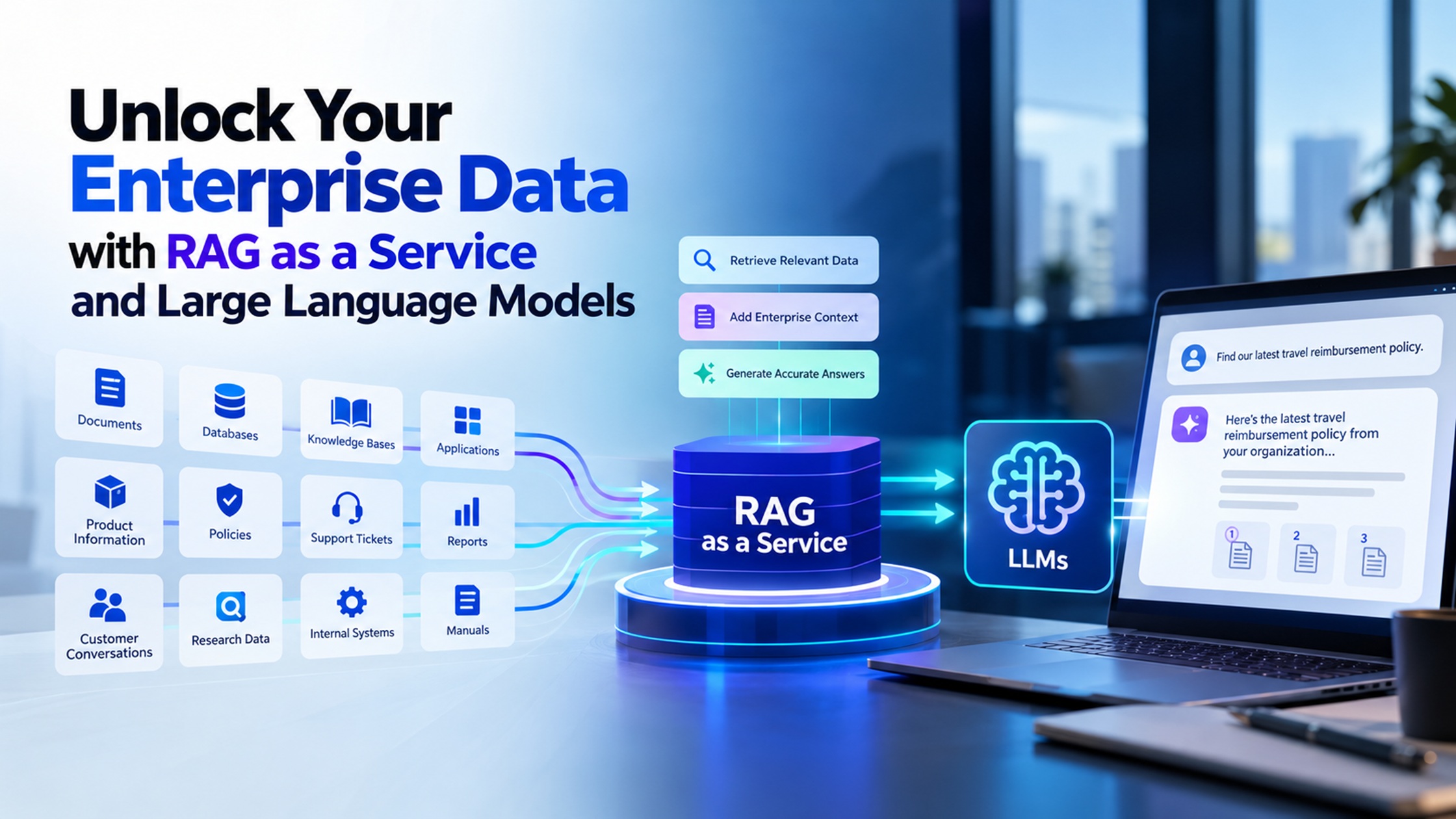
Enterprise organizations generate enormous amounts of data every day. Customer conversations, internal documents, product information, technical manuals, policies, research reports, databases, support tickets, and operational records all contain valuable knowledge. Yet much of this information remains scattered across systems and difficult for employees and customers to access when they need it. RAG as a Service helps bridge this gap by connecting enterprise data with AI-powered retrieval and Large Language Models, making relevant organizational knowledge easier to discover and use.
Large Language Models (LLMs) have introduced powerful new ways to interact with information
through natural language. However, an LLM by itself does not automatically understand an
organization’s private, proprietary, or continuously changing data. This is where Retrieval-Augmented Generation (RAG) becomes valuable.
By combining information retrieval with the capabilities of Large Language Models, RAG enables AI applications to retrieve relevant enterprise information and use it as context when generating answers. RAG as a Service takes this concept further by providing the infrastructure and capabilities organizations need to implement, manage, and scale RAG-based applications without building every component from scratch.
For businesses exploring enterprise generative AI, RAG as a Service can provide an effective
bridge between powerful LLMs and valuable organizational knowledge.
What Is RAG as a Service?
Retrieval-Augmented Generation, or RAG, is an AI architecture that combines
a retrieval system with a generative AI model.
Traditional LLMs generate responses primarily from patterns and knowledge learned during
training. This can create limitations when users ask questions involving private organizational
information, recently updated data, specialized knowledge, or information outside the model’s
training set.
RAG addresses this limitation by retrieving relevant information from an external knowledge
source before the LLM generates its response.
A typical RAG workflow looks like this:
User Query → Information Retrieval → Relevant Context → LLM →
Context-Aware Response
For example, imagine an employee asks:
“What is our current reimbursement policy for international business travel?”
Instead of relying entirely on the LLM’s general knowledge, a RAG system can search the
organization’s approved policy documents, retrieve the most relevant passages, and provide
them to the model as context for its response.
RAG as a Service (RAGaaS) packages these capabilities into a managed or
reusable service layer, helping organizations connect their data sources, retrieve relevant
information, integrate LLMs, and deploy AI-powered experiences more efficiently.
Why Enterprise Data Needs RAG
Modern enterprises often have no shortage of data. The real challenge is making that data
accessible and useful.
Important information may be distributed across:
- Document repositories
- CRM platforms
- Knowledge bases
- Product documentation
- Internal portals
- Databases
- Customer support systems
- PDFs and reports
- Cloud storage
- Policies and procedures
Employees may spend significant time searching through these sources to locate a relatively
small piece of information.
LLMs provide an intuitive conversational interface, but without access to the right enterprise
context, their answers may be generic or incomplete.
RAG creates a connection between the LLM and an organization’s knowledge ecosystem.
Instead of asking users to locate the right document manually, businesses can create AI
applications that search relevant sources and turn retrieved information into clear,
conversational answers.
How RAG as a Service Works
Although RAG implementations vary, most solutions involve several core stages.
1. Connecting Enterprise Data
The process begins by connecting relevant enterprise information sources.
These might include internal documentation, websites, databases, cloud repositories,
knowledge management platforms, product catalogs, or customer support content.
The objective is to make approved information available to the retrieval system while
maintaining appropriate access controls.
2. Processing and Indexing Information
Enterprise content is prepared for efficient retrieval.
Large documents are commonly divided into smaller sections or “chunks.”
These sections can then be transformed into numerical representations called
embeddings, which capture semantic characteristics of the content.
The embeddings and associated metadata are stored in a searchable index or vector database.
3. Understanding the User Query
When someone asks a question, the system analyzes the query and searches for information
that is semantically relevant.
Unlike basic keyword search, semantic retrieval can identify content based on meaning and
context, even when the wording differs from the original document.
4. Retrieving Relevant Context
The system identifies the most useful pieces of information related to the user’s question.
Depending on the architecture, retrieval may involve vector search, keyword search,
hybrid search, metadata filters, reranking, or combinations of these techniques.
5. Generating the Response
The retrieved information is passed to an LLM together with the user’s question and
instructions.
The LLM then uses this context to formulate a useful response.
This process allows organizations to take advantage of sophisticated language models while
grounding responses in relevant enterprise information.
Key Benefits of RAG as a Service for Enterprises
RAG as a Service can offer several important advantages for organizations adopting
generative AI.
More Relevant AI Responses
Generic LLM responses are not always sufficient for business applications.
By supplying relevant organizational information at query time, RAG can produce answers
that are more closely aligned with a company’s products, processes, policies, and knowledge.
Access to Current Information
LLMs have training cutoffs and do not inherently know when internal business information
changes.
RAG allows organizations to update the underlying knowledge sources and indexes so
applications can retrieve newer information without retraining an entire foundation model.
This is particularly valuable for industries where policies, products, regulations,
pricing, or documentation change frequently.
Reduced Risk of Unsupported Answers
One challenge associated with generative AI is hallucination, where a
model produces plausible-sounding information that is inaccurate or unsupported.
RAG does not eliminate hallucinations completely, but providing relevant source material
can substantially improve grounding. Well-designed RAG applications can also provide
citations or references that allow users to verify important answers.
Better Use of Existing Enterprise Knowledge
Organizations have already invested heavily in creating documentation, knowledge bases,
research, training materials, and internal resources.
RAG can make this information more accessible.
Instead of replacing existing knowledge systems, a RAG solution can create an intelligent
conversational layer over them.
Faster AI Development
Building an enterprise-grade RAG architecture independently can require expertise in data
ingestion, embeddings, vector databases, retrieval pipelines, LLM integration, monitoring,
security, and infrastructure.
A RAG as a Service approach can provide reusable components for these functions, helping
development teams move from experimentation to production more efficiently.
Scalability
Enterprise AI applications may eventually need to support thousands of users, millions of
documents, and high volumes of queries.
A well-designed RAG service can provide scalable infrastructure for indexing, retrieval,
model integration, monitoring, and application development.
Enterprise Use Cases for RAG as a Service
The versatility of RAG makes it useful across many business functions.
Enterprise Knowledge Assistants
Organizations can create internal AI assistants that help employees search policies,
procedures, project documentation, technical resources, and organizational knowledge.
Instead of searching multiple repositories, employees can ask questions naturally and
receive consolidated responses.
AI-Powered Customer Support
RAG can enhance customer service applications by connecting AI assistants to product
manuals, troubleshooting guides, FAQs, support articles, and other approved resources.
This can help customers receive relevant answers faster while allowing human support
teams to focus on more complex cases.
Sales Enablement
Sales teams frequently need quick access to product details, case studies, competitive
information, pricing documentation, and sales collateral.
A RAG-powered sales assistant can retrieve relevant information and help representatives
prepare responses, summarize materials, or locate resources during customer interactions.
Technical Documentation Search
Developers and technical teams often work with large volumes of documentation.
RAG systems can help users search APIs, architecture documentation, engineering guidelines,
troubleshooting materials, and other technical resources conversationally.
HR and Employee Support
Employees regularly ask questions about benefits, leave policies, onboarding, workplace
procedures, and internal programs.
A RAG-powered HR assistant can retrieve information from approved HR documents and provide
employees with a more convenient way to find answers.
Research and Analysis
Businesses can use RAG to search and synthesize information from internal research,
reports, market intelligence, and other knowledge sources.
Rather than manually reviewing numerous documents, analysts can use natural-language
queries to identify relevant information more efficiently.
RAG vs. Fine-Tuning: Understanding the Difference
RAG and fine-tuning are sometimes treated as competing approaches, but they solve
different problems.
Fine-tuning changes a model by training it further on specialized
examples. It can be useful for teaching a model particular behaviors, terminology,
styles, or task patterns.
RAG, on the other hand, provides external information to a model
when a request is made.
For enterprise knowledge applications, RAG can be particularly attractive because
business information changes frequently. Instead of retraining a model every time
documentation changes, organizations can update the connected knowledge source or
retrieval index.
In some advanced AI systems, RAG and fine-tuning can also be used together.
Security and Governance Matter
Connecting generative AI to enterprise information introduces important security
considerations.
- Access control: Users should only retrieve information they are
authorized to access. - Data privacy: Sensitive or confidential information needs appropriate
safeguards throughout ingestion, retrieval, and generation. - Source traceability: Responses should be traceable to trusted
information sources where appropriate. - Monitoring: Organizations should monitor retrieval quality, response
quality, usage patterns, and potential security issues. - Data governance: Clear policies should define which information can
be indexed, how long it is retained, and who can access it.
RAG as a Service should therefore be evaluated not only on AI capabilities but also
on its security, governance, integration, and operational controls.
What to Look for in a RAG as a Service Solution
Businesses evaluating RAG platforms should consider more than the underlying LLM. Important capabilities include flexible data connectors, scalable indexing, hybrid retrieval, metadata filtering, reranking, access-control integration, model flexibility, source citations, analytics, monitoring, and developer APIs. Organizations should also evaluate how easily the solution fits into their existing
technology ecosystem.The best RAG architecture is not necessarily the one using the largest model.
Retrieval quality, data quality, chunking strategy, permissions, prompt design,
evaluation, and application experience all influence the final result.
The Future of Enterprise AI Is Context-Aware
The first wave of generative AI demonstrated what Large Language Models could accomplish
with general knowledge. The next stage is increasingly about context. Enterprises need AI systems that understand not only language but also the information relevant to their organization, users, and workflows. RAG provides an effective architecture for delivering that context.
As retrieval technologies, embedding models, multimodal AI, agentic systems, and LLMs
continue to improve, RAG architectures are likely to become increasingly sophisticated.
Future enterprise systems may dynamically retrieve information from documents, structured
databases, APIs, images, applications, and real-time business systems before completing
complex tasks.
RAG as a Service can provide the foundation businesses need to participate in this
evolution without managing every infrastructure component themselves.
Conclusion
Enterprise data represents one of the most valuable resources available to modern organizations—but its value depends on how easily people and applications can access it.
RAG as a Service combines enterprise knowledge retrieval with the language capabilities of LLMs, enabling organizations to build AI applications that are more relevant, contextual, scalable, and grounded in business information.
From internal knowledge assistants and customer support to sales enablement, HR, research, and technical documentation, RAG can transform how businesses interact with their existing knowledge.
Organizations do not necessarily need to replace their existing data systems to take advantage of generative AI. Instead, they can create an intelligent layer that helps users discover and understand the information already available.
For enterprises seeking to move beyond generic AI experiences, RAG as a Service offers a practical path toward turning fragmented organizational data into accessible, AI-powered knowledge.