
1. AI-Powered Personalization and Smarter User Experiences
Artificial intelligence is changing how businesses deliver digital experiences, and healthcare technology websites are beginning to reflect this transformation.
Visitors arrive at medtech websites with different goals. A healthcare provider may want to explore software integrations, while a patient might be searching for product information or support resources. Investors, distributors, and hospital administrators may need entirely different details.
AI-powered features can help users find relevant information more efficiently. Depending on the website’s purpose, these features may include intelligent search, conversational assistants, personalized content recommendations, or guided product discovery.
For example, a medical software company could help visitors identify the right solution by asking about their organization size, workflow requirements, and integration needs.
However, personalization must be implemented carefully. Healthcare websites should avoid making unsupported medical recommendations or using sensitive personal information without appropriate safeguards.
Key trend: Use AI to simplify information discovery and improve navigation while keeping users informed, protected, and in control.
2. Accessibility as a Core Design Requirement
Accessibility is becoming an essential part of responsible website development. Healthcare websites serve people with different abilities, including users who rely on screen readers, keyboard navigation, captions, voice input, or alternative display settings.
An inaccessible website can prevent visitors from understanding product information, completing forms, or accessing important resources.
Future-focused Medtech Website Design places accessibility at the center of the development process rather than treating it as a feature added after launch.
Important practices include:
- Using semantic HTML and meaningful heading structures.
- Providing descriptive alternative text for informative images.
- Maintaining sufficient color contrast.
- Supporting keyboard navigation and visible focus indicators.
- Adding captions or transcripts to relevant multimedia.
- Creating accessible forms with clear labels and error messages.
- Testing with assistive technologies and users with disabilities.
Automated accessibility tools can identify certain issues, but they cannot detect every usability barrier. Manual testing and, where possible, feedback from people with disabilities remain valuable.
Healthcare businesses should also avoid relying on accessibility overlays as a substitute for fixing problems in the underlying website.
Key trend: Build accessibility into design, content, development, and quality assurance from the beginning.
3. Mobile-First Design for Healthcare on the Go
Patients, healthcare professionals, and medical technology buyers increasingly expect to access information wherever they are. A hospital administrator might review a product specification during a meeting, while a healthcare professional may need to check technical documentation between appointments.
A website that works beautifully on a desktop but becomes difficult to navigate on a smartphone can quickly lose these visitors.
In 2026, mobile-first design means more than shrinking desktop content to fit smaller screens. It requires designing the entire experience around mobile users’ needs.
Essential elements include:
- Responsive layouts that adapt to different screen sizes.
- Readable typography and clear visual hierarchy.
- Touch-friendly buttons and navigation menus.
- Short, straightforward contact and inquiry forms.
- Fast-loading images and optimized page assets.
- Easy access to product information, support, and documentation.
For medical technology companies, mobile usability can also influence business opportunities. Potential customers should be able to explore solutions, compare features, and request a demonstration without struggling with the interface.
Key trend: Design for the smallest screen first, then expand the experience for tablets and desktops.
4. Minimalist Interfaces with Clear Healthcare Messaging
Healthcare technology can be complicated. Websites often need to explain advanced medical devices, clinical software, connected healthcare systems, and technical integrations. Presenting everything at once can overwhelm visitors.
This is why minimalist design is becoming increasingly valuable.
A clean interface uses whitespace, organized content sections, readable typography, and purposeful visual elements to make information easier to understand. Instead of filling every section with technical details, effective websites guide visitors through information in a logical sequence.
For example, a healthcare software company might structure its homepage around three simple questions:
- What problem does the software solve?
- How does the solution work?
- What should visitors do next?
Supporting pages can then provide technical specifications, security information, integrations, case studies, and implementation details.
Visual storytelling can also help explain complex products. Product demonstrations, carefully designed diagrams, and short explanatory videos can communicate functionality more effectively than long blocks of text.
However, visual elements should support comprehension rather than serve as decoration. Animations should be purposeful, and visitors should be able to control motion when necessary.
Key trend: Replace information overload with a clear, structured experience that helps visitors understand your value quickly.
5. Stronger Website Security and Privacy Transparency
Trust is particularly important in healthcare. Visitors may be exploring products that process sensitive information, connect with clinical systems, or support important healthcare operations.
Consequently, security should influence both the technical foundation and the visual presentation of a medtech website.
In 2026, healthcare businesses need to communicate their security practices clearly while ensuring their websites are built with appropriate safeguards.
Security claims must also be accurate. A website should not display compliance badges or certifications unless the organization genuinely qualifies to use them.
For businesses offering healthcare software, dedicated security and compliance pages can explain relevant safeguards, certifications, data handling practices, and integration requirements.
The specific legal and regulatory obligations will depend on the company’s location, products, customers, and the types of information it processes.
Key trend: Make security an operational priority and communicate privacy practices in language that visitors can understand.
6. Seamless Integrations and Connected Digital Experiences
Healthcare technology rarely operates in isolation. Medical devices, electronic health record systems, patient portals, appointment platforms, and clinical applications may need to exchange information or work together.
A modern website should help visitors understand how a product fits into this broader ecosystem.
For example, a healthcare technology provider could present its software integrations through a dedicated directory, searchable compatibility information, or clear technical documentation.
Potential customers should be able to discover supported systems, understand implementation requirements, and identify the appropriate next step.
These features help turn a website from a static marketing channel into a practical resource throughout the customer journey.
However, integration claims must be verified. Healthcare organizations need accurate information about supported systems, interoperability limitations, and any additional configuration required.
Key trend: Present products as part of a connected healthcare ecosystem, making technical capabilities and implementation requirements easier to understand.
7. Search Optimization for Traditional and AI-Powered Discovery
Healthcare technology buyers often conduct extensive research before choosing a product or service. They may search for specific software features, compare medical technology providers, or look for solutions to operational challenges.
A well-designed website should make this research easier for people and search engines.
Search engine optimization remains important, but the way visitors discover information continues to evolve. AI-powered search experiences also increase the importance of content that answers questions clearly and demonstrates subject knowledge.
An effective strategy for Medtech Website Design should combine technical SEO, helpful content, and a logical website structure.
Consider the following practices:
Create Focused Service and Product Pages
Give each important solution its own page with clear descriptions, relevant benefits, specifications, and intended audiences.
Answer Real Customer Questions
Publish useful articles about healthcare technology challenges, product implementation, interoperability, security, and emerging industry developments.
Use Descriptive Headings
Organize information with meaningful headings that help readers understand the page without reading every paragraph.
Improve Technical Performance
Optimize images, reduce unnecessary scripts, and monitor loading speed and visual stability.
Implement Relevant Structured Data
Use appropriate schema markup where applicable, ensuring that structured information accurately reflects visible page content.
Demonstrate Credibility
Include verifiable company information, author expertise, product documentation, customer stories, and references where appropriate.
No design or SEO technique can guarantee that a website will appear in AI-generated answers. The goal is to create trustworthy, well-organized information that serves genuine user needs.
Key trend: Build website content for people first while making its structure and meaning easy for search systems to interpret.
8. Performance-Driven Design and Core Web Vitals
Website speed has a direct impact on how people experience digital services. Slow pages, unresponsive buttons, and unexpected layout shifts can make even an attractive website frustrating to use.
Healthcare technology websites often include large product images, videos, interactive demonstrations, analytics scripts, and third-party integrations. Without careful optimization, these elements can affect performance.
In 2026, performance-driven Medtech Website Design means considering speed from the beginning rather than trying to fix it after development.
Google’s Core Web Vitals provide useful measures of loading performance, responsiveness, and visual stability.
- Largest Contentful Paint (LCP): 2.5 seconds or less.
- Interaction to Next Paint (INP): 200 milliseconds or less.
- Cumulative Layout Shift (CLS): 0.1 or less.
These are the recommended thresholds for a good user experience, assessed at the 75th percentile of page visits.
To improve performance, developers can compress images, use modern image formats, reduce unnecessary JavaScript, optimize fonts, and select reliable hosting infrastructure.
Teams should also test pages on mobile devices and realistic network connections rather than relying exclusively on high-speed office internet.
Key trend: Treat performance as a core design requirement that supports usability, search visibility, and user confidence.
9. Human-Centered Design and Authentic Healthcare Storytelling
Technology may be at the heart of medtech innovation, but people ultimately use, evaluate, and depend on these solutions.
A Medtech Website Design filled with technical terminology and generic stock images can struggle to communicate what makes a company different.
Human-centered design addresses this challenge by focusing on real user needs, concerns, and decision-making processes.
For healthcare technology businesses, this may involve presenting authentic product demonstrations, sharing verified customer experiences, introducing the team behind the technology, and explaining how solutions address practical challenges.
Different audiences should also receive information relevant to their needs.
For example, a hospital administrator may prioritize operational efficiency and implementation costs. A clinician may focus on usability and workflow compatibility, while an IT manager may want detailed security and integration documentation.
User research, interviews, analytics, and usability testing can help companies understand these differences.
Visual storytelling should remain accurate and respectful. Avoid exaggerated medical claims, misleading patient imagery, or promises of clinical outcomes that cannot be substantiated.
Key trend: Combine technical expertise with clear, human-centered communication that helps visitors make informed decisions.
10. Flexible Website Architecture for Future Growth
Healthcare technology evolves quickly. Companies introduce new products, expand integrations, update documentation, and respond to changing customer expectations.
A website that is difficult to maintain can become a business limitation.
Flexible architecture allows organizations to update content, introduce new pages, and improve digital experiences without rebuilding the entire website every time their needs change.
Depending on the company’s size and technical requirements, this could involve a well-structured content management system, reusable design components, scalable hosting, or a headless content architecture.
The right approach depends on the website’s complexity, internal resources, security requirements, and integration needs. A smaller medtech company may benefit from a straightforward CMS, while a large enterprise may require a more sophisticated architecture.
Regardless of the technology chosen, the Medtech Website Design should support consistent branding, controlled publishing workflows, reliable backups, and ongoing maintenance.
Key trend: Build for adaptability, allowing the website to grow alongside the business and its products.
Conclusion: Building the Next Generation of Medtech Websites
The future of healthcare websites is not defined by visual trends alone. It is shaped by how effectively digital experiences connect technology with real human needs.
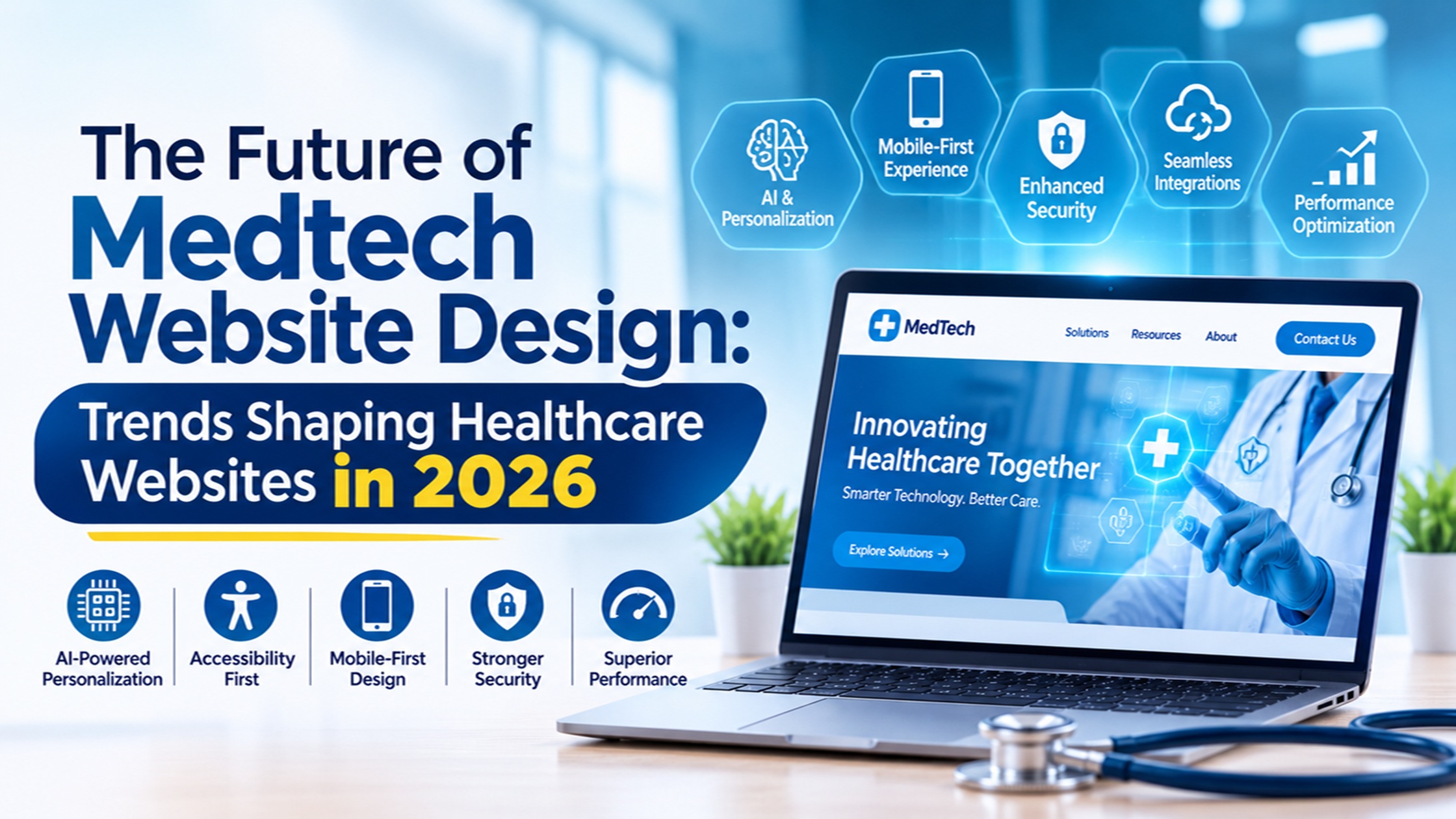
AI-powered personalization, accessibility-first development, mobile usability, stronger privacy practices, connected digital experiences, search optimization, and performance-focused design are influencing how medtech businesses compete online.
Successful Medtech Website Design brings these elements together in a cohesive experience. It helps visitors understand complex products, discover relevant information, evaluate credibility, and take meaningful action.
For healthcare technology companies planning a new website or redesign, the best starting point is to identify the needs of their audiences and establish measurable goals. From there, design and development decisions should support usability, security, accessibility, and long-term growth.
The strongest medtech websites will not simply showcase innovative technology. They will make that innovation easier to understand, access, and trust.